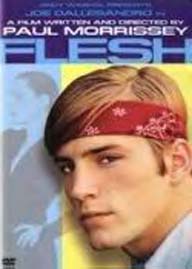
 FLESH
(1968)
FLESH
(1968)The mythos surrounding
pop artist Andy Warhol and the kooky denizens of his Factory during most of
the 1960’s has remained strong well into the 21st century. In addition
to the many coffee table books, biographies, and Warhol’s own self-penned
“Diaries,” the most enduring artifacts of the Factory are the films
shot within its own studio system, with its own unique cast of characters known
as “The Superstars.” Warhol began by setting up his camera on stationary
objects and activities (i.e., the Empire State Building, a sleeping woman, etc.),
and somehow these films became popular in arthouse circuits. Within the Factory
walls hid one of the great unsung filmmaking talents, Paul Morrissey, who was
eventually tapped to lens full-length features for Warhol. These included THE
VELVET UNDERGROUND AND NICO, THE LOVES OF ONDINE, LONESOME COWBOYS, I A MAN,
and the infamous CHELSEA GIRLS. But the peak of this creative period produced
three enduring cult classics and brought Morrissey into the limelight. Today,
Warhol usually has his name still attached to this Paul Morrissey Trilogy of
FLESH (1968), TRASH (1970), and HEAT (1972), as well as Morrissey’s other
films of the period, but the truth is that Warhol had little, if anything, to
do with these one-of-a-kind independent wonders. Of the trio, only FLESH resembles
anything Warhol “shot” earlier (think CHELSEA GIRLS and 24 HOUR
MOVIE, with no linear plot or professional technical values), and is 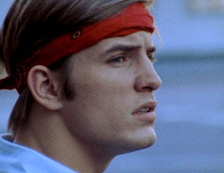 the
least effective.
the
least effective.
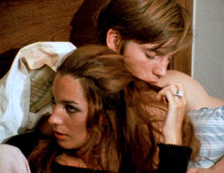
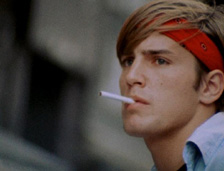
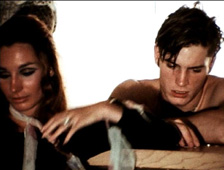
Wandering the streets of New York City, looking for his next meal ticket, is Joe, a handsome muscular male hustler with a wife and kid to support and nothing but his body to make ends meet. His day begins with a quick trick with a young fellow, then he poses for a series of cheesecake photographs for an elderly man who admires his physique. He visits girlfriends Jackie, Candy and Teri, then drops in on his best friend and gay admirer David before coming home to crash with his wife Geri and her lover Patti.
 One
doesn’t have to be gay to enjoy FLESH, but it wouldn’t hurt. The
frequent male nudity will shock those who aren’t comfortable watching
that much bare flesh, and the audience is soon thrown into the position of one
of Joe’s tricks by gawking at every inch of him presented on the screen,
which was probably Morrissey’s intent. His portrayal of a day in the life
of a male hustler was reportedly influenced by the less-than-accurate Hollywood
film MIDNIGHT COWBOY, in which members of the Warhol gang had cameos. In fact,
FLESH beat COWBOY to the theaters by almost a year and was an X-rated smash
before Hollywood dared to release their X-rated Schlesinger movie. Like that
film, Morrissey shot FLESH on the mean streets of New York City, cheap sets
and in seedy apartments, but without permits and with no script, giving the
actors a scenario and allowing them to work out the scene themselves. It doesn’t
work too well this time around, but it’s still an interesting technique.
One
doesn’t have to be gay to enjoy FLESH, but it wouldn’t hurt. The
frequent male nudity will shock those who aren’t comfortable watching
that much bare flesh, and the audience is soon thrown into the position of one
of Joe’s tricks by gawking at every inch of him presented on the screen,
which was probably Morrissey’s intent. His portrayal of a day in the life
of a male hustler was reportedly influenced by the less-than-accurate Hollywood
film MIDNIGHT COWBOY, in which members of the Warhol gang had cameos. In fact,
FLESH beat COWBOY to the theaters by almost a year and was an X-rated smash
before Hollywood dared to release their X-rated Schlesinger movie. Like that
film, Morrissey shot FLESH on the mean streets of New York City, cheap sets
and in seedy apartments, but without permits and with no script, giving the
actors a scenario and allowing them to work out the scene themselves. It doesn’t
work too well this time around, but it’s still an interesting technique.
 Before
falling into the Factory, Joe Dallesandro had become a favorite of gay men through
a series of beefcake photos by Bob Mizer of Athletic Model Guild (AMG) and a
very rare series of hardcore gay porn stag reels where he does everything imaginable
for the camera. He had appeared in the earlier Warhol epics 24-HOUR MOVIE, LONESOME
COWBOYS, LOVES OF ONDINE, and the unreleased SAN DIEGO SURF (which is only available
for viewing at the Warhol Museum in Philadelphia). FLESH was his breakout role,
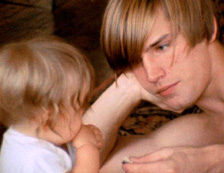
and he is in every scene. He frolics with his real-life son in a touching sequence,
and even sports a brief hard-on in a scene with Geraldine Smith! The former
Factory bouncer-turned-actor became an overnight sensation and soon found his
biggest successes in Europe during the following decade.
Before
falling into the Factory, Joe Dallesandro had become a favorite of gay men through
a series of beefcake photos by Bob Mizer of Athletic Model Guild (AMG) and a
very rare series of hardcore gay porn stag reels where he does everything imaginable
for the camera. He had appeared in the earlier Warhol epics 24-HOUR MOVIE, LONESOME
COWBOYS, LOVES OF ONDINE, and the unreleased SAN DIEGO SURF (which is only available
for viewing at the Warhol Museum in Philadelphia). FLESH was his breakout role,
and he is in every scene. He frolics with his real-life son in a touching sequence,
and even sports a brief hard-on in a scene with Geraldine Smith! The former
Factory bouncer-turned-actor became an overnight sensation and soon found his
biggest successes in Europe during the following decade.
 The
key to FLESH’s success is Dallesandro, who is more magnetic on-screen
here than most of his later films; his best scene finds him explaining the tricks
of the trade to a gawky newcomer to the hustling business. Otherwise, it’s
not the most entertaining film to watch. Punctuated by frequent shocks of white
and audio pops left in during editing to accent the documentary style of the
film, awkward improvised dialogue, and a mostly uninteresting supporting cast
of characters, FLESH is most interesting because it shows the tip of the iceberg
of what Morrissey would accomplish with his next two films (or counting WOMEN
IN REVOLT, three). And Dallesandro’s frequent exposure has made this a
perpetually popular watch for gay and female cult film fans. For these reasons,
FLESH is worth checking out, but will be quickly forgotten when confronted with
the excellent TRASH and HEAT.
The
key to FLESH’s success is Dallesandro, who is more magnetic on-screen
here than most of his later films; his best scene finds him explaining the tricks
of the trade to a gawky newcomer to the hustling business. Otherwise, it’s
not the most entertaining film to watch. Punctuated by frequent shocks of white
and audio pops left in during editing to accent the documentary style of the
film, awkward improvised dialogue, and a mostly uninteresting supporting cast
of characters, FLESH is most interesting because it shows the tip of the iceberg
of what Morrissey would accomplish with his next two films (or counting WOMEN
IN REVOLT, three). And Dallesandro’s frequent exposure has made this a
perpetually popular watch for gay and female cult film fans. For these reasons,
FLESH is worth checking out, but will be quickly forgotten when confronted with
the excellent TRASH and HEAT.
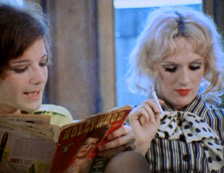
 Unlike
those follow-ups, FLESH also isn’t that funny. The best moments actually
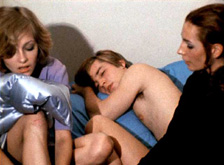
belong to sexploitation actress and stripper Geri Miller (DAUGHTERS OF LESBOS,
MEETING ON 69TH STREET). She plays herself, a stripper with an inner desire
to get implants because bigger tits bring in more cash, and even treats us to
some of her routine after telling a heartbreaking story of being raped. Used
better here than in her raincoat films, Miller is an endearing personality and
would reappear again with Dallesandro in TRASH and a brief cameo in WOMEN IN
REVOLT marked her Warhol farewell. Also present in Miller’s scenes are
Warhol queens Candy Darling and Jackie Curtis, about a year before they had
perfected their individual looks. Curtis sports a five o’clock shadow
and seems somewhat lost in her first film. Both actresses have some nice bits
of dialogue (Darling speaking longingly of Miller’s admirable bust), but
seem thrown in at the last minute and Miller mops up the floor with them. Among
the other cast members, Geraldine Smith and her twin sister Maria would make
film history as the first (only?) twin sister assassins in ANDY WARHOL’S
BAD, and also appeared together in THE LORDS OF FLATBUSH. Louis Waldon, like
Miller, would also take acting roles in New York City-area sexploitation films,
but his were more noteworthy than hers in that he chose interesting roles: an
abusive actor in ANYTHING ONCE, a member of a sex cult in THE BIZARRE ONES,
a Bogart-inspired detective in THE SPY WHO CAME. He’s good in FLESH as
the gymnast horny for best friend Joe, but he’s actually much better in
the three films mentioned above. All three are solidly recommended. Patti D’Arbanville
would inspire Cat Stevens’ excellent “Lady D’Arbanville”
on his “Mona Bone Jakon” album and despite her brief, meaningless
part in FLESH, would become the most successful performer of the cast.
Unlike
those follow-ups, FLESH also isn’t that funny. The best moments actually
belong to sexploitation actress and stripper Geri Miller (DAUGHTERS OF LESBOS,
MEETING ON 69TH STREET). She plays herself, a stripper with an inner desire
to get implants because bigger tits bring in more cash, and even treats us to
some of her routine after telling a heartbreaking story of being raped. Used
better here than in her raincoat films, Miller is an endearing personality and
would reappear again with Dallesandro in TRASH and a brief cameo in WOMEN IN
REVOLT marked her Warhol farewell. Also present in Miller’s scenes are
Warhol queens Candy Darling and Jackie Curtis, about a year before they had
perfected their individual looks. Curtis sports a five o’clock shadow
and seems somewhat lost in her first film. Both actresses have some nice bits
of dialogue (Darling speaking longingly of Miller’s admirable bust), but
seem thrown in at the last minute and Miller mops up the floor with them. Among
the other cast members, Geraldine Smith and her twin sister Maria would make
film history as the first (only?) twin sister assassins in ANDY WARHOL’S
BAD, and also appeared together in THE LORDS OF FLATBUSH. Louis Waldon, like
Miller, would also take acting roles in New York City-area sexploitation films,
but his were more noteworthy than hers in that he chose interesting roles: an
abusive actor in ANYTHING ONCE, a member of a sex cult in THE BIZARRE ONES,
a Bogart-inspired detective in THE SPY WHO CAME. He’s good in FLESH as
the gymnast horny for best friend Joe, but he’s actually much better in
the three films mentioned above. All three are solidly recommended. Patti D’Arbanville
would inspire Cat Stevens’ excellent “Lady D’Arbanville”
on his “Mona Bone Jakon” album and despite her brief, meaningless
part in FLESH, would become the most successful performer of the cast.
 There’s
no reason for anyone to hold on the old Image disc with the snap case, because
this is a vast improvement over that disc! Presented in the original fullscreen
aspect ratio, Image has remastered the film with a hi-def transfer, resulting
in gorgeous skin tones, bright colors and a clean image. A light sheet of grain
covers the film, but it was shot on cheap film stock, after all, and looks amazing
considering the primitive shooting conditions. Reds are a little strong and
slightly bleed in some sequences, but this is the best the film has ever looked,
on video and probably better than its theatrical run. While the Image disc has
been overthrown in terms of video quality, those who have the French disc in
the PAUL MORRISSEY TRILOGY 3-Disc Set may want to hold onto that one. The R2
disc edited out most of the white inserts and audio pops, resulting in the film
running slightly shorter than this R1 version, but it’s a little easier
to watch. Purists will want to stick to this Image special edition, as it presents
the film as it was meant to be seen. The mono audio, recorded cheaply and not
very well, delivers the dialogue clearly enough to understand, and the 1920’s
Al Bowlly song “Making Wicky Wacky Down in Waikiki” sounds great
in the opening scene.
There’s
no reason for anyone to hold on the old Image disc with the snap case, because
this is a vast improvement over that disc! Presented in the original fullscreen
aspect ratio, Image has remastered the film with a hi-def transfer, resulting
in gorgeous skin tones, bright colors and a clean image. A light sheet of grain
covers the film, but it was shot on cheap film stock, after all, and looks amazing
considering the primitive shooting conditions. Reds are a little strong and
slightly bleed in some sequences, but this is the best the film has ever looked,
on video and probably better than its theatrical run. While the Image disc has
been overthrown in terms of video quality, those who have the French disc in
the PAUL MORRISSEY TRILOGY 3-Disc Set may want to hold onto that one. The R2
disc edited out most of the white inserts and audio pops, resulting in the film
running slightly shorter than this R1 version, but it’s a little easier
to watch. Purists will want to stick to this Image special edition, as it presents
the film as it was meant to be seen. The mono audio, recorded cheaply and not
very well, delivers the dialogue clearly enough to understand, and the 1920’s
Al Bowlly song “Making Wicky Wacky Down in Waikiki” sounds great
in the opening scene.
 It
was a great disappointment when Image’s previous Morrissey discs were
barebones affairs, but that thankfully has been rectified with these special
editions. FLESH’s disc begins with a deleted scene, with optional commentary
by Morrissey, featuring Dallesandro having his hair cut by Smith and their discussions
about their life. It would have slowed down the first half of the film, so it’s
wise that Morrissey dropped it, but its inclusion here reveals more about the
improvised nature of the production. A much too brief stills gallery with behind-the-scenes
photos, promotional stills, and poster artwork includes Morrissey providing
commentary. Morrissey discusses his motivations behind the film, but the barely
three minutes doesn’t really allow for too many good stories about shooting
this film. Some stills were shot in 1970, at the time of FLESH’s re-release
after the success of TRASH, so Joe is seen with longer hair and Geraldine Smith
resembles a 1981 version of Toni Basil. It’s a shame Dallesandro wasn’t
interviewed for the disc, but his views of all his Morrissey films are available
in the book Little Joe Superstar, a highly recommended read.
It
was a great disappointment when Image’s previous Morrissey discs were
barebones affairs, but that thankfully has been rectified with these special
editions. FLESH’s disc begins with a deleted scene, with optional commentary
by Morrissey, featuring Dallesandro having his hair cut by Smith and their discussions
about their life. It would have slowed down the first half of the film, so it’s
wise that Morrissey dropped it, but its inclusion here reveals more about the
improvised nature of the production. A much too brief stills gallery with behind-the-scenes
photos, promotional stills, and poster artwork includes Morrissey providing
commentary. Morrissey discusses his motivations behind the film, but the barely
three minutes doesn’t really allow for too many good stories about shooting
this film. Some stills were shot in 1970, at the time of FLESH’s re-release
after the success of TRASH, so Joe is seen with longer hair and Geraldine Smith
resembles a 1981 version of Toni Basil. It’s a shame Dallesandro wasn’t
interviewed for the disc, but his views of all his Morrissey films are available
in the book Little Joe Superstar, a highly recommended read.
Related links:
For all the dirt on the making of Morrissey’s films and the people in
them, visit http://www.warholstars.org
(Casey
Scott)