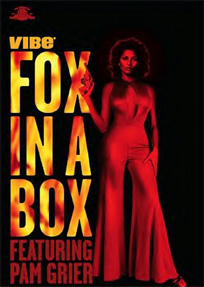
 FOX
IN A BOX: COFFY (1973), FOXY BROWN (1974), SHEBA BABY (1975)
FOX
IN A BOX: COFFY (1973), FOXY BROWN (1974), SHEBA BABY (1975)During the height
of the blaxploitation craze, American International Pictures (AIP) was adamant
about making an action film with a black leading lady. Having lost a hot property
known as "Cleopatra Jones" to Warner Bros., they employed exploitation
specialist Jack Hill to write and direct such a project. And so COFFY was born,
and Hill concocted the script specifically as a starring vehicle for Pam Grier,
veteran of several of his Filipino-made action flicks. With her exotic looks
and wildcat charms--not to forget her willingness to frequently disrobe--Grier
became an overnight sensation and COFFY was a smash for AIP, and it was quickly
followed by the likes of FOXY BROWN, SHEBA BABY and others. Originally released
on DVD in 2001, MGM/Sony have now gathered COFFY, FOXY BROWN and SHEBA BABY
with a new bonus disc in this “Fox in a Box” set commemorating the
actress.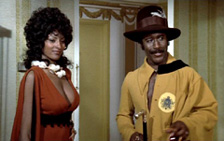
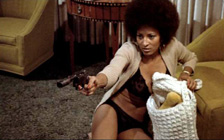
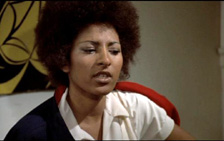
Coffy is an attractive young nurse who is determined to extinguish everyone responsible for destroying her 11-year-old sister who is comatose because of drugs. She easily lures a pusher into a bedroom, and graphically blows his head off with a shotgun. Then she forces his driver to inject himself with a fatal shot of heroin. After she alerts a nice black cop named Carter (William Elliott) of her predicament, he detects that his white partner, McHenry, is crooked and on the take.
 Carter
tells Coffy that McHenry is working with the drug mob, and that the head of
it is an Italian gangster, Vitroni (Allan Arbus). Suddenly two ski-masked thugs
burst into the apartment, since Carter won't go on the take. They rough up Coffy
and batter Carter to the point where he'll never be the same. Coffy discovers
from a prostitute that a big shot dope distributor and pimp, King George (Robert
DoQui), works for Vitroni, and she makes him the target of her retaliation.
Carter
tells Coffy that McHenry is working with the drug mob, and that the head of
it is an Italian gangster, Vitroni (Allan Arbus). Suddenly two ski-masked thugs
burst into the apartment, since Carter won't go on the take. They rough up Coffy
and batter Carter to the point where he'll never be the same. Coffy discovers
from a prostitute that a big shot dope distributor and pimp, King George (Robert
DoQui), works for Vitroni, and she makes him the target of her retaliation.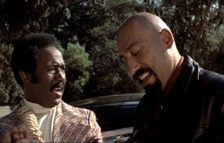
King George is introduced getting out of his limo garbed in a tacky pimp suit, complete with a funky theme song that whispers his name in a cool-ass manner ("King George...He's the King!"). The shapely Coffy has no problem convincing George to take her in his stable, enabling her plan to take on the underworld to soar. Vengeance comes in a big way for Coffy, and she does her baddest to violently wipe out those who double-crossed her.
 Jack
Hill throws in just about everything that he can to make the narrative about
crooked cops, pimps, prostitutes, lesbians, the mob, and the vengeful nurse
of the title as outrageous as possible. Loaded with comic violence, pimp George
is dragged by the bumper of his car (by Hill regular Sid Haig who's great as
an Armenian lackey) down the most obstacle-ridden allies, a catfight concludes
with a pair of razor-sliced hands after a brush with Coffy's afro, and a one-eyed
derelict is literally pulverized by Coffy's wheels at the foot of Vitroni's
front door.
Jack
Hill throws in just about everything that he can to make the narrative about
crooked cops, pimps, prostitutes, lesbians, the mob, and the vengeful nurse
of the title as outrageous as possible. Loaded with comic violence, pimp George
is dragged by the bumper of his car (by Hill regular Sid Haig who's great as
an Armenian lackey) down the most obstacle-ridden allies, a catfight concludes
with a pair of razor-sliced hands after a brush with Coffy's afro, and a one-eyed
derelict is literally pulverized by Coffy's wheels at the foot of Vitroni's
front door.
Outrageousness
seemed to be contagious in the follow-up, FOXY BROWN. Originally intended as
a continuation titled "Burn Coffy, Burn," that idea was junked after
AIP realized that their current sequels weren't doing too hot, and Hill had
to re-write the story. FOXY BROWN takes things a step further with even more
sleazy characters and more violent proceedings than its prototype. 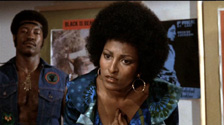
When Foxy Brown's brother Link (the incredible Antonio Fargas) is cornered at an outdoor taco stand by two members of a local dope ring, he frantically phones her to come to his rescue. As the two hoods are closing in on the hapless double-crosser, Foxy suddenly drives up, wreaks havoc with the two assassins and escorts her brother to her apartment for protection. Later, when Foxy brings home her boyfriend, Michael (Terry Carter), an undercover narcotics agent who has had plastic surgery to prevent identification by the mob, Link recognizes him.
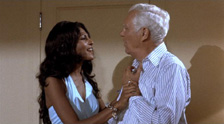 Trying
to get himself off the hook, Link phones Miss Katherine (Kathryn Loder), the
domineering head of the local dope and prostitution ring. Miss Katherine passes
the information along to her lover/enforcer Steve (Peter Brown) and he sets
up an ambush, which ends in Michael's death. Foxy is furious when she discovers
that Link was indeed the informer, and she confronts him in his love-nest where
he has sex and sniffs snow with his white mama. Making it known that she's "a
whole lotta woman," she pecks Linx's ear with a gun shot and wrecks the
joint, forcing him to reveal the name of the mob leader. Thirsting for revenge,
Foxy associates herself with Miss Katherine and becomes a part of her high-class
call girl operation (much in the same vein as in COFFY), and uses her allure
to obliterate her enemies.
Trying
to get himself off the hook, Link phones Miss Katherine (Kathryn Loder), the
domineering head of the local dope and prostitution ring. Miss Katherine passes
the information along to her lover/enforcer Steve (Peter Brown) and he sets
up an ambush, which ends in Michael's death. Foxy is furious when she discovers
that Link was indeed the informer, and she confronts him in his love-nest where
he has sex and sniffs snow with his white mama. Making it known that she's "a
whole lotta woman," she pecks Linx's ear with a gun shot and wrecks the
joint, forcing him to reveal the name of the mob leader. Thirsting for revenge,
Foxy associates herself with Miss Katherine and becomes a part of her high-class
call girl operation (much in the same vein as in COFFY), and uses her allure
to obliterate her enemies. 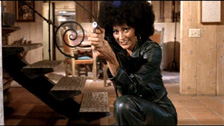
Like I mentioned before, FOXY BROWN takes the irresistible trash level of COFFY a bit further. This is exemplified in a nasty sequence where Foxy is shot full of narcotics and taken to a secluded shack on a pier, placed in the custody of two extremely grubby degenerates. After being beaten, raped and overdosed again, she maims one of the ugly mugs with a clump of wire coat hangers, and manages to escape after mercilessly setting them on fire. FOXY BROWN also boasts a turbulent brawl in a lesbian bar, a bad guy being diced by Sid Haig's plane propeller, and let's not forget the famous "pickle jar" scene, devised as a sort of retribution by Hill for a compromise he had to make with the studio's end.
 Both
COFFY and FOXY BROWN present audio commentaries by Hill. No stranger to DVD
commentaries for many of his other films (SPIDER BABY, PIT STOP, THE SWINGING
CHEERLEADERS, SWITCHBLADE SISTERS), he eases into both talks with his usual
relaxed attitude, giving a multitude of invaluable behind-the-scenes information.
Both titles were made on very limited budgets in just a little over two weeks,
and they were both completely filmed outside studios on location in California.
The director discusses the two films with fondness (although he favors COFFY
distinctly as a "much better film") and his crew and cast, especially
his revered star Grier (who used her own ingenuity in creating props for specific
scenes, namely the usage of razor blades in both films).
Both
COFFY and FOXY BROWN present audio commentaries by Hill. No stranger to DVD
commentaries for many of his other films (SPIDER BABY, PIT STOP, THE SWINGING
CHEERLEADERS, SWITCHBLADE SISTERS), he eases into both talks with his usual
relaxed attitude, giving a multitude of invaluable behind-the-scenes information.
Both titles were made on very limited budgets in just a little over two weeks,
and they were both completely filmed outside studios on location in California.
The director discusses the two films with fondness (although he favors COFFY
distinctly as a "much better film") and his crew and cast, especially
his revered star Grier (who used her own ingenuity in creating props for specific
scenes, namely the usage of razor blades in both films). 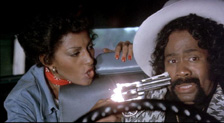
In the 1975 Grier vehicle SHEBA BABY, Sheba Shayne (Grier) is a Chicago-based private investigator, summoned back to her hometown of Louisville, Kentucky, because her father, Andy (Rudy Challenger), is in danger. Andy owns a loan company in partnership with young Brick Williams (Austin Stoker, BATTLE FOR THE PLANET OF THE APES, ASSAULT ON PRECINCT 13), Sheba's love interest. Thugs whose identity are unknown are trying to force Andy and Brick out of business and take over their company. It's later discovered that Pilot (the late D'Urville Martin), a pint-sized strong-arm man who resembles Gary Coleman with sideburns and a fuzzy mustache, is hired to deviously procure the business.
SHEBA BABY is a weaker Pam Grier vehicle, scripted and directed by cult icon William Girdler (GRIZZLY, THE MANITOU), who died in a helicopter accident in 1978. In the year previous to SHEBA, Girdler gave us ABBY (also starring Stoker and also released by AIP), the blaxploitation EXORCIST rip-off that caused a lawsuit forcing the film's removal from theatrical circulation.
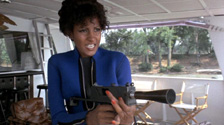 Although
the film shows a glimpse of promise with a wired car explosion and a bloody
shootout at the loan office, it quickly turns somewhat routine. The more outrageous
characters are just too stereotypical to take seriously, and Martin's bad guy
part is too wimpy (and almost likable) to be considered threatening. In the
third act, the PG-rated movie decides it wants to recycle the formula of Jack
Hill's COFFY and FOXY BROWN, throwing in a rich, white villain on a yacht, and
allowing Sheba to go undercover as a sexy floozy. Even the opening credit montage,
concentrating on shots of Pam's tight ass as she struts down the busy street,
comes off as parody. The confusingly shot climatic speedboat chase (incorporating
some obligatory gunfire and a harpoon in the villain's back) is very unsatisfying,
and overall, SHEBA BABY is OK at best.
Although
the film shows a glimpse of promise with a wired car explosion and a bloody
shootout at the loan office, it quickly turns somewhat routine. The more outrageous
characters are just too stereotypical to take seriously, and Martin's bad guy
part is too wimpy (and almost likable) to be considered threatening. In the
third act, the PG-rated movie decides it wants to recycle the formula of Jack
Hill's COFFY and FOXY BROWN, throwing in a rich, white villain on a yacht, and
allowing Sheba to go undercover as a sexy floozy. Even the opening credit montage,
concentrating on shots of Pam's tight ass as she struts down the busy street,
comes off as parody. The confusingly shot climatic speedboat chase (incorporating
some obligatory gunfire and a harpoon in the villain's back) is very unsatisfying,
and overall, SHEBA BABY is OK at best.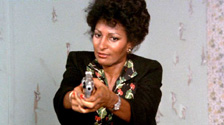
COFFY, FOXY
BROWN and SHEBA BABY carry the same transfers released by MGM some years. All
are widescreen (1.85:1), though COFFY is not 16x9 enhanced and looks the weakest
of the bunch. On a whole, colors look marvelous and there's only a hint of grain
in darker scenes, mainly due to the age of the film materials. The Dolby Digital
2.0 mono sound is excellent for films of this vintage, and audio is available
in English, Spanish and French on COFFY, English and Spanish on FOXY, and English
only on SHEBA BABY. Subtitles are available--in Spanish and French only--on
all three. Also included are the film's appropriate theatrical trailers, showcasing
the usual outlandish AIP hoopla ("She's brown sugar and spice…and
if you don't watch it, she'll put you on ice" and "The heat's on in
the street for that big bad 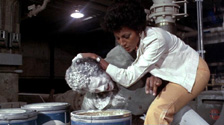 mama,
but she's doing the cooking!” for example).
mama,
but she's doing the cooking!” for example).
There’s a fourth bonus disc that’s exclusive to this set. It contains two new featurettes (each running under 20 minutes) both presented by Vibe magazine: “Pam Grier: Super Foxy” and “Blaxploitation to Hip-Hop.” Although the featurettes do not contain an appearance by Grier herself, they do feature enjoyable interviews with actors and rap artists such Vivica A. Fox, Foxy Brown, Kanye West, T.I., John Legend, Common and others. The first one explores Grier’s significance in African American culture, while the second one moves into the topic of how 1970s blaxploitation movies in general have influenced hip-hop music over the years. Clips from COFFY, FOXY and SHEBA are highlighted in the featurettes. (George R. Reis)