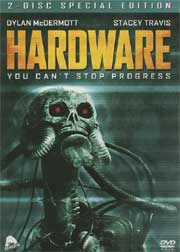
 HARDWARE
2-Disc Edition (1990)
HARDWARE
2-Disc Edition (1990)Director: Richard Stanley
Severin Films
HARDWARE
2-Disc Edition (1990)To date, Richard Stanley has only made two features – it would have been three but he was let go of his directorial duties on THE ISLAND OF DR. MOREAU (1996) – and a handful of shorts but his distinctive, habitually dystopian brand of storytelling has none the less garnered him auteur status in many cult circles. He certainly has a recognizable visual style. Disheartening narratives shrouded in omnipresent shades of red and featuring, at least briefly, someone walking alone through a desolate desert landscape, with Morocco most often providing such a setting. Even after watching his early short films, you get the distinct impression that Richard has been playing with the same ideas for sometime and that he has very little faith in the human race from preventing itself from eventually blowing everything up.
 Set
in a post-apocalyptic world, HARDWARE opens with a drifter trekking across the
uninhabitable forbidden zone that surrounds a barely thriving post nuke city.
Scanning the desert like a senior citizen at Palm Beach, the gothpunk nomad
uncovers a mechanical skull buried in the sand. In quick time the decapitated
head finds its way into the city and into the hands of Mo (Dylan McDermott,
DESTINY TURNS ON THE RADIO), a scavenger in his own right, who purchases the
severed noggin as a gift for his cloistered girlfriend, Jill (Stacey Travis,
GHOST WORLD). Locked away from the rest of the radiated world, Jill spends her
days smoking dope, watching television and constructing large metal sculptures
from scraps picked up in the gutters and alleyways of what was once a thriving
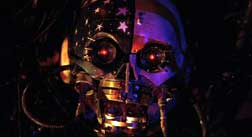
metropolis. After getting reacquainted with Mo, Jill airbrushes an American
flag on the dome of the chrome cranium and affixes it as the focus of her most
recent, and largest work of art. Awaking to find itself the center piece of
a work of post-apocalyptic art, the skull in question turns out to be from a
malfunctioning M.A.R.K. 13, a droid capable of rebuilding itself from available
materials. Left alone with only a peeping tom neighbor (William Hootkins, BATMAN)
to watch over her, Jill has to fend for herself as a reconstructed, reassembled
and overtly aggressive killing machine runs rampant throughout her apartment
and into the streets.
Set
in a post-apocalyptic world, HARDWARE opens with a drifter trekking across the
uninhabitable forbidden zone that surrounds a barely thriving post nuke city.
Scanning the desert like a senior citizen at Palm Beach, the gothpunk nomad
uncovers a mechanical skull buried in the sand. In quick time the decapitated
head finds its way into the city and into the hands of Mo (Dylan McDermott,
DESTINY TURNS ON THE RADIO), a scavenger in his own right, who purchases the
severed noggin as a gift for his cloistered girlfriend, Jill (Stacey Travis,
GHOST WORLD). Locked away from the rest of the radiated world, Jill spends her
days smoking dope, watching television and constructing large metal sculptures
from scraps picked up in the gutters and alleyways of what was once a thriving
metropolis. After getting reacquainted with Mo, Jill airbrushes an American
flag on the dome of the chrome cranium and affixes it as the focus of her most
recent, and largest work of art. Awaking to find itself the center piece of
a work of post-apocalyptic art, the skull in question turns out to be from a
malfunctioning M.A.R.K. 13, a droid capable of rebuilding itself from available
materials. Left alone with only a peeping tom neighbor (William Hootkins, BATMAN)
to watch over her, Jill has to fend for herself as a reconstructed, reassembled
and overtly aggressive killing machine runs rampant throughout her apartment
and into the streets.
 HARDWARE
was released theatrically in the U.S. via Miramax, who promoted the picture
as being the next big sci-fi, action opus ala THE TERMINATOR and ALIENS. This
rather misleading marketing campaign lead to a vocal backlash among many sci-fi
fans, who felt cheated after paying to see what is essentially an art film,
albeit one centered around a killer robot and framed by sex and gore. Such frustration
and misrepresentation was carried over for the film's home video release, as
the American VHS cover, released through HBO VIDEO, featured a quote stating
that the films was “The Best Science-Fiction thriller since ALIEN”.
Such a strong claim was wisely omitted from the cover of the Canadian tape,
which was released through Cineplex Odeon Video/MCA Home Video Canada.
HARDWARE
was released theatrically in the U.S. via Miramax, who promoted the picture
as being the next big sci-fi, action opus ala THE TERMINATOR and ALIENS. This
rather misleading marketing campaign lead to a vocal backlash among many sci-fi
fans, who felt cheated after paying to see what is essentially an art film,
albeit one centered around a killer robot and framed by sex and gore. Such frustration
and misrepresentation was carried over for the film's home video release, as
the American VHS cover, released through HBO VIDEO, featured a quote stating
that the films was “The Best Science-Fiction thriller since ALIEN”.
Such a strong claim was wisely omitted from the cover of the Canadian tape,
which was released through Cineplex Odeon Video/MCA Home Video Canada.
 While
her previous credits prove that she is more than comfortable dealing with elements
of horror and sci-fi (DOCTOR HACKENSTEIN, PHANTASM II), Stacey Travis really
steps up to the plate and into her own with her portrayal of Jill, a heroine
every bit as tough and versatile as Ripley from ALIEN. William Hootkins' portly,
pervy next door neighbor may provide the most memorable performance, but it’s
Stacey who gives the viewer someone to fawn over and route for. Also of note
are Lemmy, lead singer of Motörhead, who pops up momentarily as a seafaring
taxi driver, and Iggy Pop, who is heard and not seen as the wasteland DJ, Angry
Bob. The film's performances, though effective, are not however its strongest
suit; the visuals are. Purposely shot with an eye toward emulating Dario Argento
and Mario Bava, visually HARDWARE is a feast for the eyes. While theological
and cultural undertones may go over you head (most did mine), the film's scenery
bombards your eyes relentlessly with stark contrasting shades that help to build
a rich and palpable atmosphere that far exceeds the low budget. The majority
of the picture takes place on one set (Jill’s apartment) with only and
hand full of actors, but the attention to detail and use of colored lighting
help to set a mood that is too often found absent from more modern and costly
fare.
While
her previous credits prove that she is more than comfortable dealing with elements
of horror and sci-fi (DOCTOR HACKENSTEIN, PHANTASM II), Stacey Travis really
steps up to the plate and into her own with her portrayal of Jill, a heroine
every bit as tough and versatile as Ripley from ALIEN. William Hootkins' portly,
pervy next door neighbor may provide the most memorable performance, but it’s
Stacey who gives the viewer someone to fawn over and route for. Also of note
are Lemmy, lead singer of Motörhead, who pops up momentarily as a seafaring
taxi driver, and Iggy Pop, who is heard and not seen as the wasteland DJ, Angry
Bob. The film's performances, though effective, are not however its strongest
suit; the visuals are. Purposely shot with an eye toward emulating Dario Argento
and Mario Bava, visually HARDWARE is a feast for the eyes. While theological
and cultural undertones may go over you head (most did mine), the film's scenery
bombards your eyes relentlessly with stark contrasting shades that help to build
a rich and palpable atmosphere that far exceeds the low budget. The majority
of the picture takes place on one set (Jill’s apartment) with only and
hand full of actors, but the attention to detail and use of colored lighting
help to set a mood that is too often found absent from more modern and costly
fare.
 Released
on Blu-Ray and in a 2-Disc Special Edition, HARDWARE just might be Severin’s
finest work to date. The film’s widescreen (1.85:1) anamorphic transfer
is nothing short of amazing. With hardly a blemish to be found, the picture
boasts rich coloring, detail sharp enough to slice bread and most noticeably,
deep, distinguishing black levels. Darkened scenes, and there are several, are
remarkably lucid allowing for a totally new experience for anyone who missed
the film's theatrical run and is only familiar with the material via VHS or
bootleg. Audio, which is presented in 5.1 Dolby Digital Surround and Dolby Surround
2.0, is equally as impressive, providing due service to the film's soundtrack
- which features tracks by Public Image Ltd., Ministry and Motörhead -
and Simon Boswell’s infectious score.
Released
on Blu-Ray and in a 2-Disc Special Edition, HARDWARE just might be Severin’s
finest work to date. The film’s widescreen (1.85:1) anamorphic transfer
is nothing short of amazing. With hardly a blemish to be found, the picture
boasts rich coloring, detail sharp enough to slice bread and most noticeably,
deep, distinguishing black levels. Darkened scenes, and there are several, are
remarkably lucid allowing for a totally new experience for anyone who missed
the film's theatrical run and is only familiar with the material via VHS or
bootleg. Audio, which is presented in 5.1 Dolby Digital Surround and Dolby Surround
2.0, is equally as impressive, providing due service to the film's soundtrack
- which features tracks by Public Image Ltd., Ministry and Motörhead -
and Simon Boswell’s infectious score.
 Along with the feature itself, disc one of Severin’s 2-Disc Special Edition
features an audio commentary track with writer/director, Richard Stanley. Although
Richard claims to not be fond of commentary tracks, he is certainly not shy
when it comes to discussing his films, or pretty much anything else for that
matter. Rather soft spoken, the South African native delves right in discussing
scenes envisioned but never shot, reoccurring iconography that seems to filter
into all of his work and the confusion as to the film's location. Originally
intended to be placed in London, it appears that Miramax’s influence relocated
the setting to the States. The track is highly enjoyable as Richard comes across
as a man who does his homework and speaks rather unfiltered about any topic
posed to him.
Along with the feature itself, disc one of Severin’s 2-Disc Special Edition
features an audio commentary track with writer/director, Richard Stanley. Although
Richard claims to not be fond of commentary tracks, he is certainly not shy
when it comes to discussing his films, or pretty much anything else for that
matter. Rather soft spoken, the South African native delves right in discussing
scenes envisioned but never shot, reoccurring iconography that seems to filter
into all of his work and the confusion as to the film's location. Originally
intended to be placed in London, it appears that Miramax’s influence relocated
the setting to the States. The track is highly enjoyable as Richard comes across
as a man who does his homework and speaks rather unfiltered about any topic
posed to him.
 Disc
two kicks off with "NO FLEAH SHALL BE SPARED", an exclusive 54 minute
documentary that features interviews with Stanley, Stacey Travis, Lemmy, producer
Stephen Woolley, cinematographer Steven Chivers and conceptual designer Graham
Humphreys, to name a few. The documentary features several bits of insight that
are repeated from the commentary track, such as Dylan McDermott’s pointing
out the originally unintended biblical association with the films destructive
droid, the M.A.R.K. 13, but is in and of itself one of the most thorough and
enjoyable extras I’ve seen from Severin, or any other distributor this
year.
Disc
two kicks off with "NO FLEAH SHALL BE SPARED", an exclusive 54 minute
documentary that features interviews with Stanley, Stacey Travis, Lemmy, producer
Stephen Woolley, cinematographer Steven Chivers and conceptual designer Graham
Humphreys, to name a few. The documentary features several bits of insight that
are repeated from the commentary track, such as Dylan McDermott’s pointing
out the originally unintended biblical association with the films destructive
droid, the M.A.R.K. 13, but is in and of itself one of the most thorough and
enjoyable extras I’ve seen from Severin, or any other distributor this
year.
 INCIDNENTS
IN AN EXPANDING UNIVERSE is a 43 minute Super 8 film that serves as a precursor
and in many ways a prequel to HARDWARE. The film provides framework for Mo and
his buddy Shades, setting up the circumstances that lead to Mo's damaged hand
and the relationship that he shared with a certain young female. The influence
of BLADE RUNNER, MAD MAX and STAR WARS are front and center in INCIDNENTS but
when you consider the limited funds and materials available to Richard at the
time, what he was able to accomplish is really quite extraordinary. The transfer
is about what one would expect from a Super 8 feature almost 25 years old, but
therein lay its charm. Audio is often hard to follow and the picture certainly
shows its age, but as a herald to HARDWARE, the film's inclusion is more than
welcomed. THE SEA OF PERDITION is a ten minute short film shot in 2006. The
short follows a female astronaut who uncovers a deadly body of water after crash
landing on a deserted red planet. RITES OF PASSAGE is an early eight minute
short film which features Richard himself as a savage primordial man. When placed
beside Subversive Cinema’s Collector's Edition of DUST DEVIL, released
in 2006, almost all of Richard’s film endeavors can presently be found
on DVD, save for BLACK TULIPS a short film which can currently be found on YouTube.
INCIDNENTS
IN AN EXPANDING UNIVERSE is a 43 minute Super 8 film that serves as a precursor
and in many ways a prequel to HARDWARE. The film provides framework for Mo and
his buddy Shades, setting up the circumstances that lead to Mo's damaged hand
and the relationship that he shared with a certain young female. The influence
of BLADE RUNNER, MAD MAX and STAR WARS are front and center in INCIDNENTS but
when you consider the limited funds and materials available to Richard at the
time, what he was able to accomplish is really quite extraordinary. The transfer
is about what one would expect from a Super 8 feature almost 25 years old, but
therein lay its charm. Audio is often hard to follow and the picture certainly
shows its age, but as a herald to HARDWARE, the film's inclusion is more than
welcomed. THE SEA OF PERDITION is a ten minute short film shot in 2006. The
short follows a female astronaut who uncovers a deadly body of water after crash
landing on a deserted red planet. RITES OF PASSAGE is an early eight minute
short film which features Richard himself as a savage primordial man. When placed
beside Subversive Cinema’s Collector's Edition of DUST DEVIL, released
in 2006, almost all of Richard’s film endeavors can presently be found
on DVD, save for BLACK TULIPS a short film which can currently be found on YouTube.
Early on in its development Richard planed to expand the universe of the M.A.R.K. 13 with a sequel, which would have delved deeper into the droids primary function. In an eight minute interview Richard recounts his plans for such a project which, thanks to a lengthy legal battle over ownership, never had a chance at seeing the light of day. Twenty five minutes of deleted and alternate scenes provide a glimpse at some of the action and visuals which were eventually cut from the American theatrical print in order to insure an R rating. Sourced from a decades old VHS tape in Stanley's possession, the footage is in fare enough condition although audio is absent from several scenes. The picture's German theatrical trailer and a promo reel wrap up and impressive release for a film that has been long overdue for proper restoration. (Jason McElreath)