 JOURNEY
TO THE CENTER OF THE EARTH (1959)
JOURNEY
TO THE CENTER OF THE EARTH (1959)Director: Henry Levin
20th Century-Fox Home Entertainment
JOURNEY
TO THE CENTER OF THE EARTH (1959)At long last one of the great
moviegoing pleasures of this writer's childhood is now available on DVD courtesy
of 20th Century-Fox. To see this entertaining film restored for this widescreen
(2.35:1 aspect ratio and 16x9) edition is cause for celebration for all science-fiction
enthusiasts everywhere.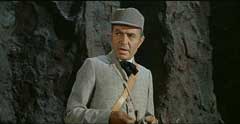
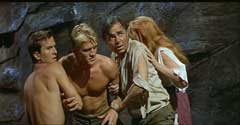
Filmed in 1959 on the coattails of Walt Disney's successful adaptation of Jules Verne's 20,000 LEAGUES UNDER THE SEA, Fox wisely hired its star, James Mason, and surrounded him with top flight production values and a respectable cast. Your reviewer takes this opportunity to say that Pat Boone is more than competent as the young student who inadvertently discovers the key to the earth's core.
Jules Verne's novel had been filmed before but one may consider this the definitive screen version of his 1864 adventure. Scripted by Billy Wilder's ex-partner, Charles Brackett, he takes the usual liberties with the original source material, giving us a rather headstrong and attractive heroine, played with great dignity by the exquisite Arlene Dahl.
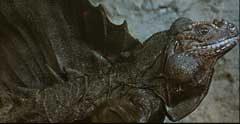
 At
132 minutes this may bother today's audience more accustomed to fast-moving,
digitally-enhanced special effects and one can complain about the substitution
of lizards and various reptiles made up to look like dinosaurs of prehistoric
times, but part of the charm of this film is the wholeheartedness with which
this film was undertaken. For 1959, JOURNEY TO THE CENTER OF THE EARTH was probably
the most lavish B-picture ever made with gigantic sets and backdrops to create
the two worlds above and below the earth's surface.
At
132 minutes this may bother today's audience more accustomed to fast-moving,
digitally-enhanced special effects and one can complain about the substitution
of lizards and various reptiles made up to look like dinosaurs of prehistoric
times, but part of the charm of this film is the wholeheartedness with which
this film was undertaken. For 1959, JOURNEY TO THE CENTER OF THE EARTH was probably
the most lavish B-picture ever made with gigantic sets and backdrops to create
the two worlds above and below the earth's surface.
The incomparable James Mason is
the glue that holds this project together. His is a masterful and energetic
performance as the crusty, absent-minded professor, Sir Oliver Lindenbrook.
 From the beginning as we are informed of his knighthood and all Edinburgh is
at his feet, he inadvertently walks through a parade of grenadiers unruffled
as he reads of his accomplishments in the local paper. Mason's authoritative
voice aids greatly in describing what would seem implausible in a less gifted
actor's range. His awe at discovering the light that shines on the entrance
to the center of the earth atop Mt. Scartarus is full of grandeur that only
Mason can register.
From the beginning as we are informed of his knighthood and all Edinburgh is
at his feet, he inadvertently walks through a parade of grenadiers unruffled
as he reads of his accomplishments in the local paper. Mason's authoritative
voice aids greatly in describing what would seem implausible in a less gifted
actor's range. His awe at discovering the light that shines on the entrance
to the center of the earth atop Mt. Scartarus is full of grandeur that only
Mason can register.
 The
photography of Leo Tover is first-rate and manages the difficult task of creating
a subterranean world of multicolored stalactites, stalagmites and other rock
formations. The sequence in which James Mason and the film's villain, Count
Saknussen (Thayer David of DARK SHADOWS fame) witness the underground ocean
is simply breathtaking and utterly believable.
The
photography of Leo Tover is first-rate and manages the difficult task of creating
a subterranean world of multicolored stalactites, stalagmites and other rock
formations. The sequence in which James Mason and the film's villain, Count
Saknussen (Thayer David of DARK SHADOWS fame) witness the underground ocean
is simply breathtaking and utterly believable. 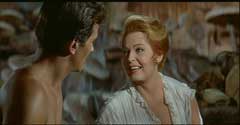
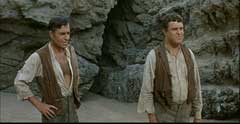
The score for JOURNEY TO THE CENTER OF THE EARTH was created by the incomparable Bernard Hermann, and next to the James Mason performance, is the most important aspect of this film. Hermann's ominous tones that reverberate from the very beginning credits are awe-inspiring and evoke a true sense of adventure. His contribution is crucial to the appreciation of the motion picture as a whole. Whenever the effects seem trivial, his music saves the day by informing every plot point with a sense of urgency.
 In
the 40 years that have elapsed since this film, special effects have become
so taken for granted that it is difficult for today's audiences to understand
how magnificent this film appeared to those that saw it at the time. The flaws
are there, particularly in the comic relief of the Icelandic bodybuilder, Hans
and his pet duck, Gertrude and the inevitable crooning of teen heartthrob Pat
Boone. JOURNEY has so much authentic excitement and sense of
In
the 40 years that have elapsed since this film, special effects have become
so taken for granted that it is difficult for today's audiences to understand
how magnificent this film appeared to those that saw it at the time. The flaws
are there, particularly in the comic relief of the Icelandic bodybuilder, Hans
and his pet duck, Gertrude and the inevitable crooning of teen heartthrob Pat
Boone. JOURNEY has so much authentic excitement and sense of 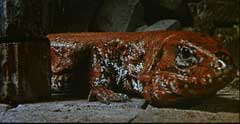 wonder
that it is easy to overlook such minor annoyances.
wonder
that it is easy to overlook such minor annoyances.
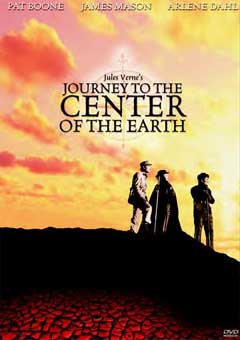
This edition is basically no frills but includes a trailer narrated by James Mason that this reviewer had never seen before and its condition is pristine for its age. The jacket is very deceptive and although the American poster art is rather garish, it would be easy to overlook what the film is based on the photograph that is used for the front piece which makes it look more like a documentary rather than a motion picture itself.
The restoration of this edition is vividly presented in a supplemental track on the disc that clearly shows the state of erosion and fading that had befallen the negative. Dramatically we see how important film preservation is if we are to enjoy seeing our classic films as they were first seen in theaters for generations to follow. (David Del Valle)