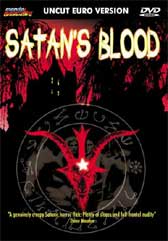
 SATAN’S
BLOOD (1977)
SATAN’S
BLOOD (1977)Director: Carlos Puerto
Mondo Macabro
SATAN’S
BLOOD (1977)Post-Franco Spanish horror
offered its repressed, sensation-and-spectacle-hungry audiences a torrid flow
of blood, sex, and brutality. Free from the restrictions of a government and
religious impulse that had traded truth and sensation for false exteriors of
morality and a hypocritical status quo that dictated life in art as well as
everyday life, writers and filmmakers sought to exercise their own demons and
the violent impulses of their culture through the sexual freedom, violent excess,
and supernatural symbolism of their movies…. and created a unique brand
of filmmaking, equal parts spectacle and reflection. 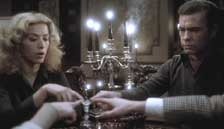
There is something special, something unique, about the Spanish horror sub-genre. No matter the degree of slap-dash production qualities, bad acting, or cheesy monster/gore effects, there is a sense of truth in thee intentions (if not always the result) of the filmmakers, which endears Spanish fright and exploitation productions to the adventurous film fan. Entrenched in the soil of a native land whose domestic terrors included the Inquisition and a formable amount of supernatural folklore, Spanish horror cinema, from nasty Naschy to such modern cerebral thrillers as THE NAMELESS are somehow connected to the earth, the organic elements of repulsion, fear, and desire making monsters of us all, or, at the very least, showing the monsters that we always were. Gritty, animalistic, and inherently sexual, Spanish horror and exploitation cinema is also much more intelligent than it is given credit for. Full of heavily-muscled men and sensuous snake-like women, these visceral powerhouses appeal to both the kid and the adult in our skins, satisfying that secret, sometimes acknowledged, more often denied internal hunger for destruction, chaos, and the horrific. Someone once made the astute comment that horror movies are fairy tales for adults. And that is precisely one of the levels in which SATAN'S BLOOD – a movie of satanic madness, sexual sadism, and black magic – succeeds so very well.
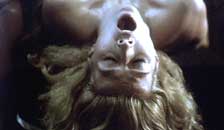 This
dizzying ménage of satanic ritual and hidden agendas is most definitely
a fairy tale for adults. Asking us to enjoy the very elements that it uses to
set us at unease, its cannibal witches may be disguised as scantly clad seductresses
and shadows from a murky past but they’re our to eat you just the same
– your spirit, your sanity, your sense of identity. At the same time,
its subversive story, careful direction, and commendable performances make it
an unflinching expose of corruption – breakdowns of mind, and spirit reflected
by ravishments of the flesh. While gothic in atmosphere, even approaching the
surreal in terms of its lush, decrepit setting, a lurking sense of brutality
throbs beneath the surface of even the quieter moments in this movie, the suggestion
of suspense throbbing beneath even the most innocent dialogue and character
development. Undeniably surreal, intensely sexual, and unsettlingly beautiful
in its depiction of practices and behaviors that should make us queasy, Puerto
exhibits an impressive ability to make the terrible desirable and the repulsive
seductive. He focuses an unblinking eye on sweaty bodies writhing in ecstasy
one moment, the next shoving us into scenes of disturbing unease, making us
question our own delight in debauchery even as we enjoy it. Further, the direction
and slow pacing of the movie provokes the questioning of reality, unfolding
in the hazy distortion of a dream. Like the best examples of surrealism and
expressionistic theater, the story, while not always making sense on a surface
level, evokes a sense of reality and meaning in an internal sense.
This
dizzying ménage of satanic ritual and hidden agendas is most definitely
a fairy tale for adults. Asking us to enjoy the very elements that it uses to
set us at unease, its cannibal witches may be disguised as scantly clad seductresses
and shadows from a murky past but they’re our to eat you just the same
– your spirit, your sanity, your sense of identity. At the same time,
its subversive story, careful direction, and commendable performances make it
an unflinching expose of corruption – breakdowns of mind, and spirit reflected
by ravishments of the flesh. While gothic in atmosphere, even approaching the
surreal in terms of its lush, decrepit setting, a lurking sense of brutality
throbs beneath the surface of even the quieter moments in this movie, the suggestion
of suspense throbbing beneath even the most innocent dialogue and character
development. Undeniably surreal, intensely sexual, and unsettlingly beautiful
in its depiction of practices and behaviors that should make us queasy, Puerto
exhibits an impressive ability to make the terrible desirable and the repulsive
seductive. He focuses an unblinking eye on sweaty bodies writhing in ecstasy
one moment, the next shoving us into scenes of disturbing unease, making us
question our own delight in debauchery even as we enjoy it. Further, the direction
and slow pacing of the movie provokes the questioning of reality, unfolding
in the hazy distortion of a dream. Like the best examples of surrealism and
expressionistic theater, the story, while not always making sense on a surface
level, evokes a sense of reality and meaning in an internal sense. 
Literally beginning with a bang as a woman is stabbed during the throes of sexual climax, the story then introduces us to a couple deciding to go for a drive in the country. Bored and looking for excitement, Ana, who is pregnant, and her husband Andres, leave the familiar streets of their home town into a night of terror. Discovering another couple on their excursion, they realize that the mysterious Bruno claims to know Andres, although our hero can’t recall him. Despite this, in admittedly ridiculous fashion, Ana and Andres agree to go accompany them to their home far into the empty countryside. Not wishing to be impolite, feeling awkward yet bound by social mannerisms, they agree to spend the night at the country home of their new friends, Andres and Bertha. The splendidly gothic castle, remote in its physical location, anticipates the deterioration and isolation that the characters will soon experience in their psyches as good taste, safety, and sanity are exchanged for occult parlor games, orgies, and death. When the truth of a horrid situation is partially revealed, amidst celebrations of perverse sex, satanic ritual, and cat-and-mouse Giallo flavored pursuits, we, like the characters, are unsettled instead of terrified, but this is due to the nightmarish suggestion of the storyline. An undercurrent of menace seems to be the goal of the filmmakers, not outright horror, and this is achieved admirably well.
 Struggling
to survive in a tangled net of betrayal, conspiracy, and death, Ana and Andres,
in surprisingly reflective bouts of character development, must face the crippling
instincts of their own emotions as well as physical threats. While these moments
of retrospection may make the viewing experience more satisfying for those who
like brains with their blood and breasts, the fan looking for nothing more than
spectacle may well be bored by elongated scenes and a story that requires patience
to properly weave its spell. Crafting a carefully structured, believably filmed
story of satanic perversion and flimsy barriers between reality and the perception
with which we define the possible world around us and our own place within it,
this occult thriller delivers atmospheric if not gory goods. While there is
a dulling lack of narrative excitement/action midway through the satanic festivities,
and the direction has to struggle to make up for it, the climax helps resurrect
the predominating sense of fear and fantasy so very pertinent to this movie.
Struggling
to survive in a tangled net of betrayal, conspiracy, and death, Ana and Andres,
in surprisingly reflective bouts of character development, must face the crippling
instincts of their own emotions as well as physical threats. While these moments
of retrospection may make the viewing experience more satisfying for those who
like brains with their blood and breasts, the fan looking for nothing more than
spectacle may well be bored by elongated scenes and a story that requires patience
to properly weave its spell. Crafting a carefully structured, believably filmed
story of satanic perversion and flimsy barriers between reality and the perception
with which we define the possible world around us and our own place within it,
this occult thriller delivers atmospheric if not gory goods. While there is
a dulling lack of narrative excitement/action midway through the satanic festivities,
and the direction has to struggle to make up for it, the climax helps resurrect
the predominating sense of fear and fantasy so very pertinent to this movie.

At times illogical (as many Spanish films are), Puerto’s startling, enjoyable romp of Satanism and sadism is both smart and professionally photographed. An impressive degree of quality is maintained in the production – evident in the interior shots, the lighting, and sparse special effects. Despite a limited budget, an overall sense of professionalism is evident in the story and its realization. One is tempted to wonder if the lack of big budget didn’t instigate creativity, with Juan Piquer Simon producing (initially set to direct), and Puerto effectively managing his cast and surroundings to evoke a funeral air to the suspense. While obviously similar in plot and thematic conventions to other satanic films of the period (and after), unavoidably compared with Polanski’s THE TENANT and the wonderful if little known EYE OF THE DEVIL, this one-way ride to hell attains its own identity in a genre too often blasted by critics for a lack of seriousness. Chills and uneasy arousal are offered in good measure, and a sense of tension lurks below the surface throughout. If logic is shed as much as bodily fluids, we needn’t worry, for this movie is more about atmosphere than plot continuity. Atmosphere is apparent not just in the sets but the unusually fine acting of the cast, embodied primarily in Angel Aranda and Mariana Karr. Karr’s face is, similar to Barbara Steele, both voluptuous (in the beginning) and seductively menacing (later in the film). For the most part playing it innocent, the attractiveness of her face reaffirms the belief in her basic innocent nature required to buy the film’s premise. Another stand out if minor role is the gate-keeper on the weird duo’s estate, played with typical if under-appreciated sulking skill by Luis Barboo.
 Receiving
an S for sex and sadism in its native Spain, the visual and audio presentation
of this disc receives an ‘A’ for effort of preservation and presentation.
Occasional spotting in the film is only so noticeable because the majority of
the 1.66:1 anamorphic transfer looks so lovely. Said spotting pops up only now
and then, and it isn’t very distracting. Images are sharp and clear, colors
vibrant as a cannibal witch’s candy house. Overall, this is a clean, sharp
transfer of an incredibly rare movie. Extras include a rather academic introduction
to the film, which comes across as silly rather than the serious piece it was
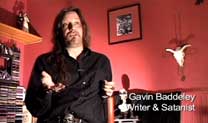
intended as. This is followed by "The Devil's Disciples," a thoughtful
segment where this Church of Satan authority describes more fully the relationship
between genre and Satanic philosophy, lending greater appreciation, authenticity,
and enjoyment to the film. In this segment, the obviously intelligent, well
read speaker discusses his interpretation of Satanism, contrasting this with
the fictional treatment by such authors as Dennis Wheatley (The Devil Rides
Out, The Satanist) and the sensationalism as such cult of personalities
as Crowley (aka ‘The Great Beast’). This discussion, interwoven
with film clips from DON’T DELIVER US FROM EVIL, the wonderful SATANICO
PANDEMONIUM, and our feature presentation, is meaty and cerebral. A gallery
of promotional material and film stills, linear notes from Pete Tombs, an alternative
epilogue, and the usual, entertaining preview reel round out the future. A lovingly
crafted release of a culturally significant nightmare of surrealism and sexuality,
Satan’s Blood spills as much brains as blood! (William
P. Simmons)
Receiving
an S for sex and sadism in its native Spain, the visual and audio presentation
of this disc receives an ‘A’ for effort of preservation and presentation.
Occasional spotting in the film is only so noticeable because the majority of
the 1.66:1 anamorphic transfer looks so lovely. Said spotting pops up only now
and then, and it isn’t very distracting. Images are sharp and clear, colors
vibrant as a cannibal witch’s candy house. Overall, this is a clean, sharp
transfer of an incredibly rare movie. Extras include a rather academic introduction
to the film, which comes across as silly rather than the serious piece it was
intended as. This is followed by "The Devil's Disciples," a thoughtful
segment where this Church of Satan authority describes more fully the relationship
between genre and Satanic philosophy, lending greater appreciation, authenticity,
and enjoyment to the film. In this segment, the obviously intelligent, well
read speaker discusses his interpretation of Satanism, contrasting this with
the fictional treatment by such authors as Dennis Wheatley (The Devil Rides
Out, The Satanist) and the sensationalism as such cult of personalities
as Crowley (aka ‘The Great Beast’). This discussion, interwoven
with film clips from DON’T DELIVER US FROM EVIL, the wonderful SATANICO
PANDEMONIUM, and our feature presentation, is meaty and cerebral. A gallery
of promotional material and film stills, linear notes from Pete Tombs, an alternative
epilogue, and the usual, entertaining preview reel round out the future. A lovingly
crafted release of a culturally significant nightmare of surrealism and sexuality,
Satan’s Blood spills as much brains as blood! (William
P. Simmons)
Check out the Mondo Macabro website by clicking HERE.