 DEATH
JOURNEY (1976)
DEATH
JOURNEY (1976)Director: Fred Williamson
Code Red Releasing
DEATH
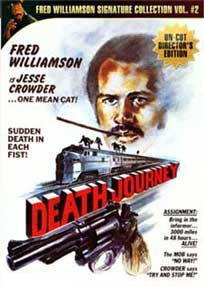
JOURNEY (1976)Already having successful starring roles in early 1970s urban action flicks such as HAMMER (1972), BLACK CAESAR (1973), HELL UP IN HARLEM (1973) and THAT MAN BOLT (1973), Fred “The Hammer” Williamson took the initiative to make his own low budget, independent movies. Knowing that his name was marketable in the U.S. as well as overseas, Williamson formed his Po' Boy Productions to produce, direct and star in the kind of features he wanted to make and that his fans would expect him to be in. Shot in 1975, DEATH JOURNEY was the maiden adventure of Williamson’s character Jessie Crowder, a tough ex cop/PI who would return over the next decade in NO WAY BACK (1976), BLIND RAGE (1978) and THE LAST FIGHT (1982).
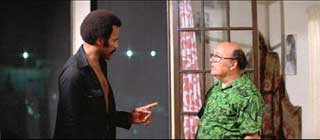
A New York mobster is about to go on trial, but all who can testify against him become fodder for target practice. A bald, chubby accountant named Finley (Bernard Kirby), who is living in California, is the last hope as a witness to testify, so D.A. Virgil Riley (Art Maier) and his reluctant assistant (Lou Bedford, THE HAPPY HOOKER) hire Jessie Crowder (Fred Williamson) to protect and escort Finley across the country (in 48 hours time). An ex cop with martial arts skills, Crowder (much like Dirty Harry) is known for his unorthodox methods and that his presence is sure to turn up a handful of cadavers, but he’s the only man right for the job. From almost the minute Crowder picks up the portly Finley, the bad guys are on their tail, wrecking their sports car, as they are forced to trek on foot and use any means of transportation possible to get to their destination. With trigger happy thugs at every corner, that’s going to be no easy task, especially when Crowder keeps loosing his spineless accomplice whenver his back is turned.
 With
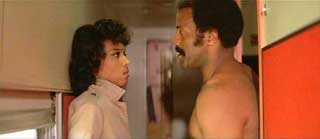
a simply laid out plot and only a few pages of actual script, DEATH JOURNEY
is a film that gets around its budgetary restraints by moving the action from
state to state (California to New York, and a number of locations in between)
always sustaining a variety of popcorn thrills on the screen – numerous
chases, fight scenes (usually Crowder up against a bunch of toughies or the
odd disguised assassin) and shootouts. The unflappable Crowder is a fun character,
a “love ‘em and leave ‘em” type who has no trouble telling
women to piss off or throw them off a train if they threaten him, and he’s
audacious enough to answer his front door in the buff (to greet a blonde beauty
played by Heidi Dobbs, one of his many conquests). While Crowder is most interested
in bedding the ladies, completing his mission, and collecting his $25,000 (which
he later ups to $50,000 after a dozen attempts are made on his life), his companion
Finley (a short, rotund comic foil for Williamson, complete with an assortment
of loud Hawaiian shirts) is more interested in unwrapping his travel bag full
of chocolate bars, frequenting concession stands and dodging insults about his
weight from his overly macho protector. Among the cast of mostly unknowns is
“guest star” D'Urville Martin (Williamson’s frequent co-star/sidekick)
in a quick cameo.
With
a simply laid out plot and only a few pages of actual script, DEATH JOURNEY
is a film that gets around its budgetary restraints by moving the action from
state to state (California to New York, and a number of locations in between)
always sustaining a variety of popcorn thrills on the screen – numerous
chases, fight scenes (usually Crowder up against a bunch of toughies or the
odd disguised assassin) and shootouts. The unflappable Crowder is a fun character,
a “love ‘em and leave ‘em” type who has no trouble telling
women to piss off or throw them off a train if they threaten him, and he’s
audacious enough to answer his front door in the buff (to greet a blonde beauty
played by Heidi Dobbs, one of his many conquests). While Crowder is most interested
in bedding the ladies, completing his mission, and collecting his $25,000 (which
he later ups to $50,000 after a dozen attempts are made on his life), his companion
Finley (a short, rotund comic foil for Williamson, complete with an assortment
of loud Hawaiian shirts) is more interested in unwrapping his travel bag full
of chocolate bars, frequenting concession stands and dodging insults about his
weight from his overly macho protector. Among the cast of mostly unknowns is
“guest star” D'Urville Martin (Williamson’s frequent co-star/sidekick)
in a quick cameo.
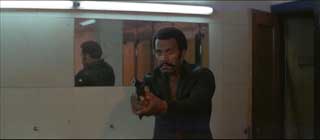
As is the case with Code Red’s DVD release of MEAN JOHNNY BARROWS, their DEATH JOURNEY is something of a revelation. Previously available on a number of budget labels in horrid full frame transfers (mostly taken from the Unicorn VHS release from the 1980s), the film is presented here in all its uncut 2.35:1 Panavision glory with anamorphic enhancement, in a transfer made from the original camera negatives. The picture looks absolutely terrific, with crisp detail and vivid colors, and next to nothing in the way of grain or blemishes. The English mono audio track also comes off nicely.
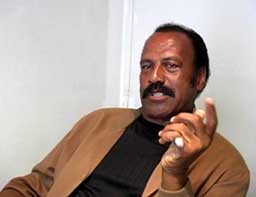 Williamson
is back for Part 2 of a video interview (Part 1 can be found on Code Red’s
MEAN JOHNNY BARROWS disc), and this one lasts nearly half an hour. Here the
Hammer talks about DEATH JOURNEY, how an old friend tried to sue him for using
his namesake (Jesse Crowder), and touches upon various films he starred in and/or
directed, including some of the exploitation flicks he made in Italy during
the late 1970s and 1980s. With all sorts of behind-the-scene stories about shooting
the film in various locations (without permits) in different states, Williamson
is on hand for an audio commentary moderated by Code Red’s William Olsen.
Fred also discusses a number of scene-specific details, including how he did
his own stunts during his on-screen confrontations, and Olsen keeps the questions
flying – the banter between the two of them is a lot of fun, so be sure
to listen. The full frame trailer for DEATH JOURNEY is included, as are Code
Red trailers for NO WAY BACK, MEAN JOHNNY BARROWS, BRUTE CORPS and CHOKE CANYON.
George
R. Reis)
Williamson
is back for Part 2 of a video interview (Part 1 can be found on Code Red’s
MEAN JOHNNY BARROWS disc), and this one lasts nearly half an hour. Here the
Hammer talks about DEATH JOURNEY, how an old friend tried to sue him for using
his namesake (Jesse Crowder), and touches upon various films he starred in and/or
directed, including some of the exploitation flicks he made in Italy during
the late 1970s and 1980s. With all sorts of behind-the-scene stories about shooting
the film in various locations (without permits) in different states, Williamson
is on hand for an audio commentary moderated by Code Red’s William Olsen.
Fred also discusses a number of scene-specific details, including how he did
his own stunts during his on-screen confrontations, and Olsen keeps the questions
flying – the banter between the two of them is a lot of fun, so be sure
to listen. The full frame trailer for DEATH JOURNEY is included, as are Code
Red trailers for NO WAY BACK, MEAN JOHNNY BARROWS, BRUTE CORPS and CHOKE CANYON.
George
R. Reis)